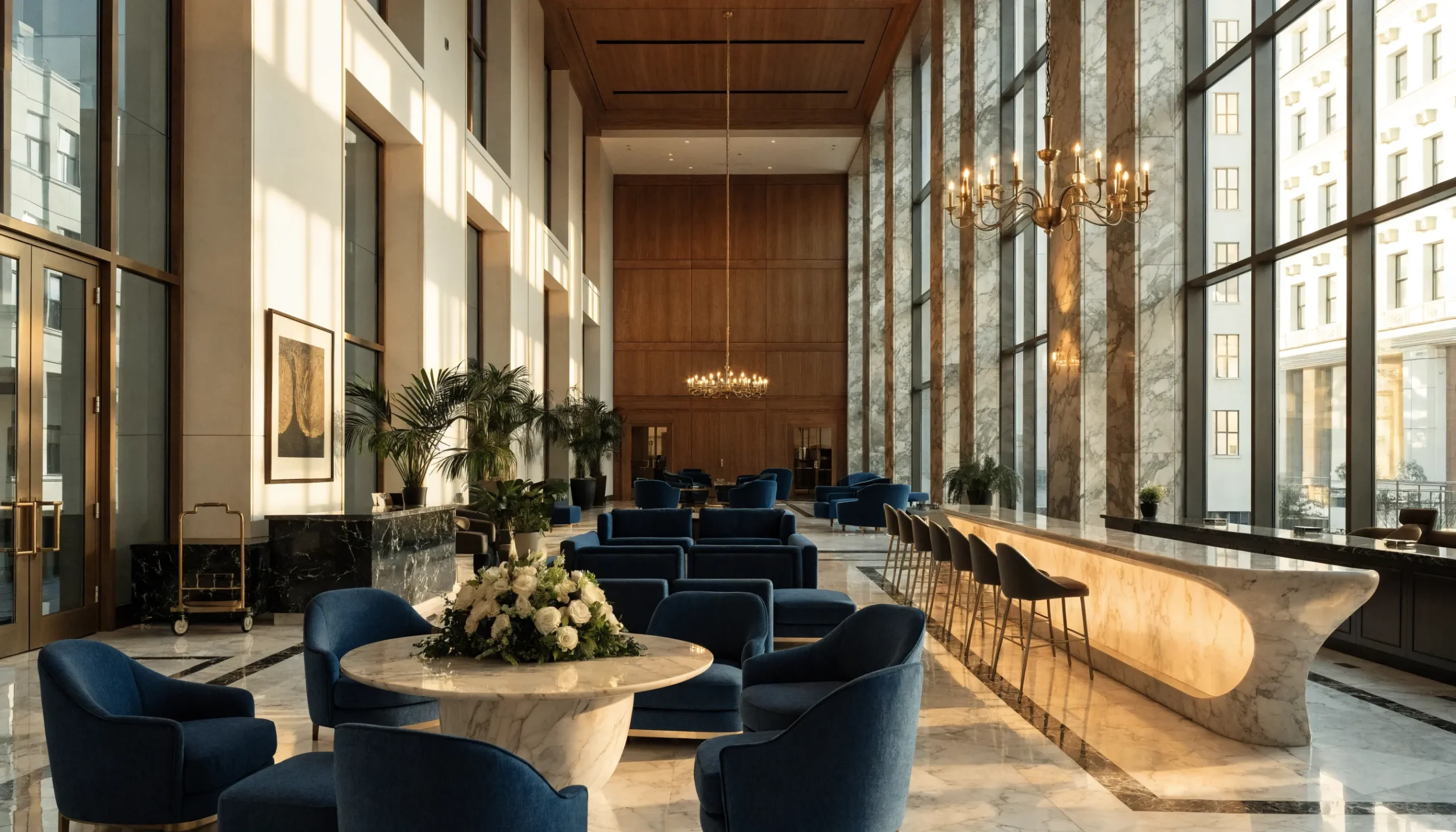
This hotel procurement glossary defines the 60+ terms used most often on FF&E and OS&E projects — from FF&E, OS&E, CapEx and cost-per-key to value engineering, bid leveling, mock-up rooms, par levels and snagging. Each entry is a plain-English definition written for hotel owners, developers and asset managers planning or reviewing a procurement programme.
Last updated: June 2026 · Written by the procurement team at Stoch Hotel Consulting, an independent FF&E & OS&E procurement company operating across Europe since 2011.
Hotel procurement has a language of its own, and the same word can mean different things to a designer, a contractor and an accountant. The definitions below are grouped by theme — categories and accounting, budgeting and cost, the procurement process, manufacturing and quality, logistics and installation, item types, and brand and operational terms — so you can read it end to end or jump to the section you need.
Categories and accounting
FF&E. Furniture, Fixtures & Equipment: the durable, movable items that furnish a hotel — beds, casegoods, seating, lighting, mirrors, artwork and joinery — but are not permanently built into the structure. Treated as a capital asset with a five-to-ten-year life.
OS&E. Operating Supplies & Equipment: the operational items needed to open and run the hotel, such as linens, towels, glassware, chinaware, cutlery, kitchen smallwares, amenities and uniforms. Replenished continuously as it is consumed.
CapEx (capital expenditure). Money spent to acquire long-life assets, such as FF&E. It sits in the development budget and is depreciated over the asset’s useful life rather than expensed in a single year.
OpEx (operating expenditure). Day-to-day running costs, including most OS&E replenishment. Expensed in the period it is incurred rather than capitalised.
FF&E reserve. A fund set aside from operating revenue — commonly around 3–5% of room revenue — to pay for future FF&E replacement and refurbishment, so the asset can be renewed without a separate capital call.
Useful life. The number of years an asset is expected to remain in service before replacement. It drives the depreciation schedule and the timing of refurbishment cycles.
Depreciation. The accounting method that spreads the cost of a capital asset across its useful life, reflecting the gradual reduction in its value.
Asset register. The record of a hotel’s capital assets, including FF&E, used for accounting, insurance and replacement planning. Clean FF&E / OS&E separation keeps it accurate.
Opening stock. The initial quantity of OS&E purchased before opening. The first fill is usually capitalised; subsequent replenishment is an operating cost.
Budgeting and cost terms
Cost per key. A project cost expressed per guestroom (“key”). FF&E and OS&E budgets are often benchmarked this way because it allows comparison between properties of different sizes.
Budget breakdown. The division of a total FF&E or OS&E budget into categories (for example guestrooms, public areas, food & beverage, back-of-house) so that spending can be tracked and controlled line by line.
Allowance. A provisional sum included in a budget for an item not yet fully specified or priced. It is replaced by a firm cost once the specification is confirmed.
Contingency. A reserve within the budget to absorb unforeseen costs, change orders or price movements without derailing the overall figure.
Value engineering (VE). A structured review that reduces cost while preserving design intent, quality and guest experience — for example by re-specifying materials, adjusting construction methods or re-sourcing, rather than simply buying cheaper.
Hard costs. Costs of physical items and construction — the furniture, fixtures and materials themselves.
Soft costs. Costs that are not the physical product, such as design fees, procurement fees, freight, duties, storage and installation.
Landed cost. The total cost of an item delivered to site, including the product price plus freight, insurance, duties and handling. Comparing suppliers on landed cost — not ex-works price — prevents misleading savings.
Bill of quantities (BOQ). An itemised schedule of every product, quantity and specification required, used as the basis for tendering and cost control.
The procurement process
Procurement. The end-to-end process of specifying, sourcing, negotiating, buying, manufacturing, inspecting, shipping and installing the goods a hotel needs — not simply placing orders.
Owner’s procurement agent. An independent purchasing partner that buys on the investor’s behalf, protecting the budget and brand standards rather than acting for a contractor or supplier. Also called a purchasing agent.
Specification (spec). The detailed description of an item — dimensions, materials, finishes, performance and standards — that defines exactly what must be supplied and tested against on delivery.
FF&E schedule. The master list linking every specified item to its location, quantity, supplier and budget line. The backbone of cost and delivery control.
RFP (request for proposal). A document inviting suppliers to propose how they would meet a requirement, including approach and price.
RFQ (request for quotation). A request asking suppliers to price a defined specification, used when the requirement is already fixed.
Competitive tendering. Inviting multiple qualified suppliers to bid on the same specification so that pricing, lead time and quality can be compared objectively.
Bid leveling. Normalising competing quotes onto a like-for-like basis — same specification, quantities, freight and terms — so the true lowest cost is visible and hidden exclusions are exposed.
Supplier (vendor). A manufacturer or distributor that produces or provides specified goods.
Lead time. The period between placing an order and the goods being ready or delivered. Long lead times on custom FF&E usually drive the project’s critical path.
Purchase order (PO). The formal contract document that commits to buying specified goods at an agreed price, quantity and delivery date.
Milestone payments. Payments released in stages — typically a deposit, a balance before shipment, and a retention — tied to production progress rather than paid all at once.
Incoterms. Standard international trade terms (such as EXW, FOB, CIF, DDP) that define where responsibility and cost for goods pass from supplier to buyer during shipping.
Manufacturing and quality
Custom (bespoke). Items manufactured to a project’s own specification rather than bought as a standard product. Most signature FF&E in luxury hotels is custom.
Catalogue product. A standard, off-the-shelf item available from a supplier’s existing range, usually with shorter lead times than custom work.
Prototype. A first physical example of a custom item, produced so design, construction and quality can be checked and approved before full production.
Mock-up room (model room). A fully fitted sample guestroom built before full production, used to confirm design, specification, quality and operational fit, and to sign off FF&E and OS&E before committing to volume orders.
Strike-off. A pre-production sample of a printed or woven textile or wallcovering, approved for colour and pattern before bulk manufacturing.
CFA (cutting for approval). A small physical sample cut from an actual production run of fabric or carpet, approved to confirm the bulk material matches the standard.
Pre-production sample (PPS). A sample made on production tooling before the full run, used as the final quality benchmark for approval.
Quality control (QC). Inspection of goods during and after manufacturing — including factory inspections — to confirm they meet specification before they ship.
Snagging (punch list). The process of identifying and recording defects or incomplete work after installation so they can be corrected before final acceptance.
Defects liability. A contractual period after handover during which the supplier must remedy faults that appear in normal use.
Logistics and installation
Freight forwarder. A specialist that arranges and manages the transport of goods from factories to the hotel site, often across multiple countries and modes.
Consolidation. Combining shipments from several suppliers into coordinated deliveries to reduce cost, simplify handling and control the sequence of arrivals on site.
Customs clearance. The process of meeting import requirements and paying any duties and taxes so goods can legally enter the destination country.
Duties. Taxes charged on imported goods, which form part of the landed cost and must be budgeted from the start.
Warehousing. Temporary storage of goods that are produced before the site is ready to receive them, coordinated so items arrive in the right order for installation.
Installation. Placing, assembling and fixing FF&E in the hotel, sequenced with construction completion and snagging.
Handover. The formal transfer of completed, inspected spaces from the project team to the operator, ready for opening.
Item types
Casegoods. Hard furniture items such as wardrobes, desks, nightstands, headboards and dressers — typically wood or wood-look construction.
Soft goods. Textile-based FF&E such as upholstery, cushions, bed runners, decorative pillows, drapery and area rugs.
Upholstery. Furniture with padded, fabric- or leather-covered surfaces, such as lounge chairs, sofas and headboards.
Window treatments. Drapery, sheers, blackout curtains and decorative blinds, usually procured within FF&E.
Par level. The standard stock quantity of an OS&E item kept on hand — often expressed in multiples per room (for example three par of bed linen) — to cover items in use, in laundry and in reserve.
Smallwares. Small kitchen and bar equipment and tools, such as pots, pans, utensils and service items, within OS&E.
Operating equipment. Chinaware, glassware and flatware (cutlery) used in food and beverage service — a core part of OS&E.
Amenities. Guest consumables such as bathroom toiletries, slippers and in-room collateral, replenished room by room.
Brand and operational terms
Brand standard. The detailed requirements an operator sets for a branded hotel, covering design, quality, specification and quantities that FF&E and OS&E must meet.
PIP (property improvement plan). A defined schedule of upgrades a brand requires for an existing hotel joining or renewing under its flag, often triggering significant FF&E procurement.
Operator. The management company that runs the hotel, frequently under a brand, and sets the standards the procurement must satisfy.
Owner’s representative. A party acting for the investor to oversee the project and protect the owner’s interests across design, construction and procurement.
Responsibility matrix. A document defining who buys, supplies and installs each item — owner, operator, contractor or designer — to prevent gaps, overlaps and double-counting between packages.
“We are not order placers. We are investment protectors.”
— Stoch Hotel Consulting
Frequently asked questions
What does FF&E mean?
FF&E stands for Furniture, Fixtures & Equipment — the durable, movable items that furnish a hotel, such as beds, casegoods, seating, lighting and artwork, but are not permanently built into the structure. It is treated as a capital asset with a useful life of roughly five to ten years.
What does OS&E mean?
OS&E stands for Operating Supplies & Equipment — the operational items a hotel needs to open and run, including linens, towels, glassware, chinaware, cutlery, kitchen smallwares, amenities and uniforms. Unlike FF&E, it is consumed and replenished continuously and is treated mainly as an operating cost.
What is value engineering in hotel procurement?
Value engineering is a structured review that reduces cost while preserving design intent, quality and guest experience. It works by re-specifying materials, adjusting construction methods or re-sourcing items — not by simply buying the cheapest option, which often costs more over the asset’s life.
What is a mock-up room?
A mock-up room, or model room, is a fully fitted sample guestroom built before full production. It is used to confirm design, specification, quality and operational fit, and to sign off FF&E and OS&E before committing to large volume orders — the single most effective quality-control step in guestroom procurement.
Plan your hotel procurement with Stoch Hotel Consulting
Stoch Hotel Consulting is an independent FF&E and OS&E procurement company based in Kraków, operating across Europe since 2011. We turn this vocabulary into a controlled, transparent process that protects the investor’s budget, timeline and brand standards. For the full picture, read our complete guide to FF&E and OS&E procurement for hotels, or tell us about your development and we will show you how independent procurement protects your investment.
About the author. Iwona Stoch is the Founder and Strategic Lead of Stoch Hotel Consulting. She combines strategic oversight with hands-on involvement, setting procurement direction and protecting investor interests across luxury and upscale hotel projects throughout Europe.