By Iwona Stoch, Founder & Strategic Lead, Stoch Hotel Consulting
A contract textile is a fabric engineered and tested for commercial use, not a fabric bought off a residential roll. Two ratings decide whether it belongs in a hotel: the Martindale rub count, which measures abrasion resistance in test cycles, and a flame rating, which certifies the fabric meets ignition-safety requirements for non-domestic seating. Upholstery and curtains are tested under different standards for different risks — treating them as one “flame rating” is a common specification gap.
Both numbers get quoted constantly in FF&E (furniture, fixtures and equipment) specification documents, and both get misunderstood constantly — not because they’re complicated, but because fabric suppliers rarely explain what the number is actually testing for, or where its limits sit. This is what each rating measures, what a hotel should specify as a minimum, and why a fabric that passes both tests on paper can still fail in the field.
What is a contract textile, and how is it different from a fabric bought for a home?
A contract textile (also called contract fabric or commercial-grade fabric) is upholstery or window-treatment fabric manufactured and independently tested to withstand continuous public and commercial use — far beyond what a residential fabric is engineered for. It sits inside the soft goods portion of a hotel’s FF&E scope, alongside carpet and drapery, distinct from the hard furniture (casegoods) and fixed equipment in the same room. A residential fabric is tested, if at all, against domestic-use assumptions: occasional seating, infrequent professional cleaning, one household’s wear pattern. A contract textile is tested against a hotel’s actual conditions — a new guest most nights of the year, cleaning by housekeeping staff rather than the owner, and years of continuous turnover before the piece is due for replacement.
That difference is exactly what the two ratings below are built to measure: how much mechanical wear the fabric can take before it visibly degrades (the Martindale rub count), and how it behaves near an ignition source in a building full of people who didn’t choose to be there (the flame rating).
What does the Martindale rub count actually measure, and what’s the minimum for a hotel?
The Martindale test is the abrasion-resistance method most commonly specified for contract upholstery in Europe. A sample of the fabric is mounted on a testing machine and rubbed against a standard abradant in a figure-eight motion; the machine counts the number of rub cycles — the rub count — until the fabric shows visible thread breakage or wear. The method itself is formally defined by an international standard, ISO 12947 (parts 2 and 3), which sets out how the test is run and how wear is assessed — a peer-reviewed materials-science study using contactless optical profilometry to track Martindale wear tests within this same standard family (see Matusiak & Kosiuk, Materials, 2025, on Martindale abrasion assessment).
The standard defines how to measure abrasion; it does not set a pass/fail number for hotel use. Those minimums are an industry convention, and the most widely cited source for them is the Association for Contract Textiles (ACT), the US-based trade body whose performance guidelines are referenced across the contract furnishings industry. ACT rates general or low-traffic contract fabric at a minimum of 20,000 Martindale cycles, and fabric intended for high-traffic public spaces — the category a hotel lobby or restaurant chair falls into — at a minimum of 40,000 cycles (see ACT’s abrasion performance guidelines).
| Fabric use category | ACT minimum rub count (Martindale) | Typical hotel application |
|---|---|---|
| General / low-traffic contract use | 20,000 cycles | Rarely enough on its own for guest-room seating in continuous use |
| High-traffic public space (ACT floor) | 40,000 cycles | Lobby, restaurant and bar upholstery |
| Stoch Hotel Consulting’s guest-room specification | 40,000–50,000 cycles (our practice minimum, above ACT’s general-use floor) | Guest-room armchairs and sofas |
That guest-room figure comes from what actually holds up across the properties Stoch Hotel Consulting specifies for, not from a published norm — which is exactly why it needs to be written into the spec book explicitly rather than assumed from the ACT floor alone.
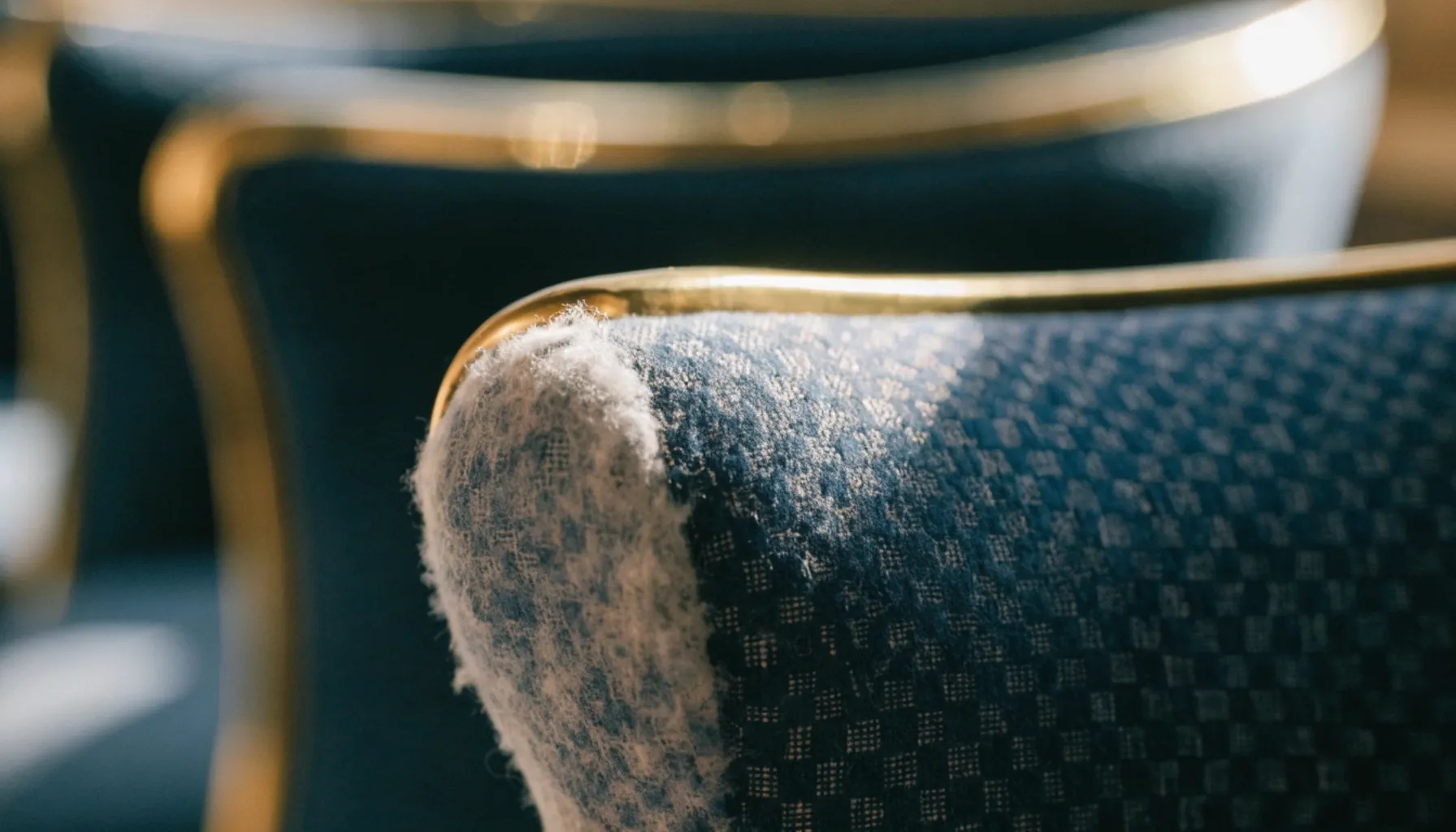
“The basis for choosing a fabric isn’t only how flame-retardant it is or how it needs to be cleaned — it’s also how many abrasion cycles it’s rated for. The higher, the better. We specify a minimum of 40,000 to 50,000 cycles, but even then, the fabric often ends up failing at the corners and seams first,” says Iwona Stoch, founder of Stoch Hotel Consulting.
What do flame ratings mean for hotel upholstery — and are curtains held to the same standard?
No — and this is the gap that trips up a lot of FF&E specifications. Upholstered seating and window-treatment fabric are tested against entirely different flame standards, because they fail in different ways: a chair is tested for how it responds to a smouldering or flaming ignition source in contact with it, while a curtain is tested for how it behaves after repeated industrial washing, since a curtain’s flame-retardant treatment can wash out over time in a way upholstery’s doesn’t.
For upholstered seating, the accredited British testing body FIRA International lists the standards used to certify furniture for non-domestic (contract) use: BS 5852, which tests ignitability from smouldering and flaming sources, BS EN 1021-1 and -2 (cigarette and match-flame ignition sources respectively), and BS 7176 — the standard written specifically for the resistance to ignition of upholstered furniture in non-domestic seating, as opposed to furniture built for the home (see FIRA International’s flammability testing standards). These are British Standards, not a single pan-European rule; EN 1021 is the standard with formal European status, while the BS 5852/BS 7176 suite is widely used as a reference point across European FF&E specifications even outside the UK. A property outside the UK should confirm which standard its jurisdiction or brand operator actually requires rather than assume the two are interchangeable.
Curtains and drapery sit under a separate standard again: BS 5867 Part 2, where “Type B” is the classification most commonly specified for hotel public areas and guest rooms, requiring the fabric to retain its flame-retardant performance through a set number of industrial wash cycles — “Type C”, with a higher wash-cycle requirement, is reserved for higher-risk environments such as hospitals (see FR-One on BS 5867 Part 2 Type A, B and C). A curtain certified to BS 5867 Part 2 Type B says nothing about whether the same base fabric would pass the ignition tests used for upholstered seating — they’re different tests for different failure modes, and a spec book that lists a single “flame rating” covering both categories is missing a distinction that matters.
Why does fabric still fail even when it passes on rub count?
Because the rub count is measured on a flat, uninterrupted piece of fabric under a testing machine, and a real armchair or sofa isn’t flat or uninterrupted. Corners, piping, and seams concentrate stress in a way the Martindale test doesn’t reproduce — which is why, as Iwona Stoch notes above, a fabric rated at 40,000–50,000 cycles can still show visible wear at those specific points well before the rest of the panel does. A high rub count is necessary; it isn’t sufficient on its own to predict where or when a piece will actually need reupholstering.
That gap is exactly why the rub count feeds into FF&E replacement cycles rather than settling them outright: understating the required rub count at the spec stage is one of the most common reasons upholstered furniture reaches the end of its useful life years ahead of the CapEx schedule that assumed it.
Where do these numbers get enforced in a hotel FF&E project?
Both ratings belong in the spec book — the document that sets performance minimums for every FF&E category before sourcing begins — not in a supplier’s sales sheet. In practice, the interior designer selects a fabric for colour, pattern and hand-feel; it’s the procurement agent‘s job to check the supplier’s actual test certificate against the spec book’s minimum rub count and flame rating before that selection is approved for order. That verification step is where a fabric that looks right on a mood board but carries a 15,000-cycle domestic rating, or a flame certificate for the wrong test method, gets caught before it reaches a guest room. This is the same discipline behind value engineering in hotel FF&E: checking that a cheaper fabric alternative still clears the performance minimum, not just the visual brief.
Frequently asked questions
What’s a safe minimum Martindale rub count for hotel guest-room upholstery?
The Association for Contract Textiles sets 40,000 cycles as its floor for high-traffic public-space fabric. Stoch Hotel Consulting specifies 40,000–50,000 cycles as a practice minimum for guest-room seating specifically — above the ACT public-space floor, because guest-room chairs and sofas see continuous turnover with less oversight than a supervised lobby.
Do hotel curtains need to meet the same flame standard as upholstered seating?
No. Upholstered seating is typically tested under BS 5852 and the related BS EN 1021 / BS 7176 suite, which assess ignition from smouldering or flaming sources in contact with the fabric. Curtains and drapery are tested under a separate standard, BS 5867 Part 2, which assesses whether flame-retardant performance survives repeated industrial washing. A certificate for one does not cover the other.
Is BS 5852 a European standard or a UK one?
BS 5852 and BS 7176 are British Standards, not pan-European Euronorms. EN 1021 is the standard with formal European status. In practice, the BS suite is widely referenced in European FF&E specifications as an accepted benchmark, but a property outside the UK should confirm with its brand operator or local authority which standard actually applies before treating them as interchangeable.
Who checks the rub count and flame rating before a fabric order goes out?
The interior designer typically selects the fabric; the procurement agent is responsible for verifying the supplier’s test certificates against the spec book’s minimum rub count and flame rating before that selection is approved for purchase.
Does a higher rub count guarantee a fabric will last the full FF&E replacement cycle?
No. The Martindale test measures wear on a flat fabric sample; it doesn’t reproduce the stress concentrated at seams, corners and piping on an actual upholstered piece, which is often where visible wear appears first regardless of how high the fabric’s rated rub count is.
Iwona Stoch is the founder and strategic lead of Stoch Hotel Consulting, an independent FF&E and OS&E procurement consultancy based in Kraków, working with luxury and upscale hotels across Europe since 2011.
Last updated: September 2026.
Talk to Stoch Hotel Consulting about specifying contract textiles for your project.