By Iwona Stoch, Founder & Strategic Lead, Stoch Hotel Consulting
Hotel furniture desert climate durability comes down to two different attacks: inland desert heat, dust and low humidity dry out and crack wood and stone, while coastal salt and humidity corrode metal and fade fabric. FF&E (furniture, fixtures and equipment) specified for only one profile usually fails against the other within a year or two.
Most FF&E specification decisions for Gulf hotels are made by looking at a sample in a showroom, or by copying a material list from a project built somewhere else in the region. That works until the finish sits through its first full year on site. Riyadh and Doha are not the same climate, and a hotel on the Red Sea coast doesn’t age the way a resort outside Dubai does — even though both sit in what procurement teams generically call “the Gulf.” Getting the durability call right means separating desert stress from coastal stress before a single purchase order is written.
What actually damages hotel FF&E in the Gulf’s desert and coastal climates?
The two dominant climate profiles across Gulf Cooperation Council (GCC) markets put different loads on the same categories of FF&E — the furniture, fixtures and equipment a hotel installs and doesn’t consume, as distinct from OS&E (operating supplies and equipment) like linen or glassware.
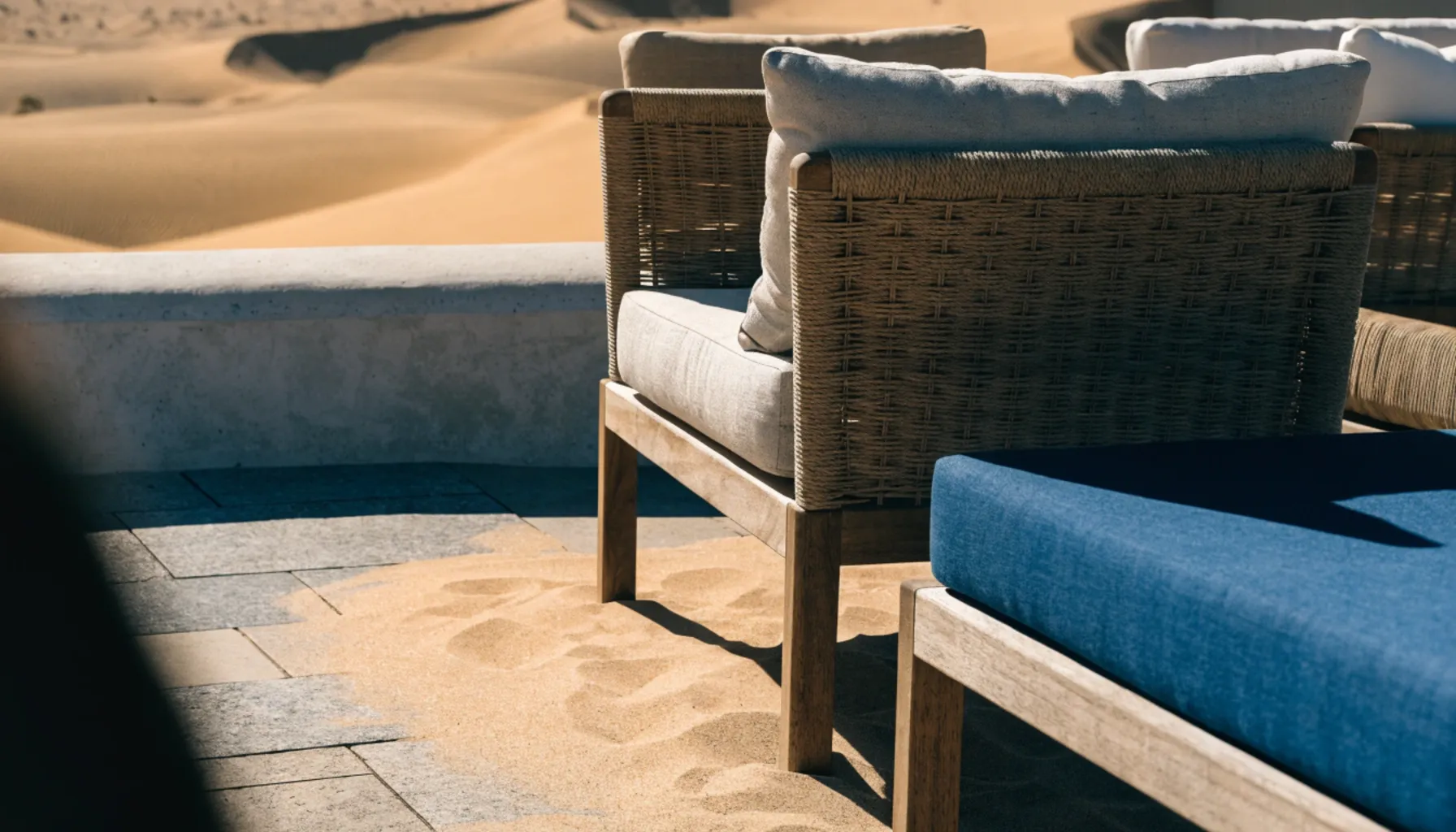
Inland desert properties — Riyadh, inland Saudi Arabia, much of the wider desert interior — combine intense ultraviolet (UV) exposure, extreme daytime temperatures, wind-blown dust and sand, very low humidity, and wide swings between day and night temperature. Coastal Gulf properties — Dubai, Abu Dhabi, Doha, Jeddah, the Red Sea coast — combine the same UV load with salt-laden air, sustained humidity and wind, and in resort settings, blown sand as well.
The two profiles share UV as a common enemy but diverge everywhere else: desert conditions dry materials out and crack them; coastal conditions corrode and rot them. A specification written for one does not automatically hold up against the other.
Which materials fail, and under which conditions?
The table below maps the failure mode we see most often against the climate factor that causes it, and the alternative that actually holds up.
| Material | Climate factor | Failure mode | Alternative that holds up |
|---|---|---|---|
| Hot-dip galvanized steel (railings, exterior fittings) | Coastal salt aerosol + sustained humidity | The zinc coating reacts with chlorides in the salt-laden air and dissolves into soluble zinc chloride, which washes away and exposes the underlying steel to corrosion | Marine-grade stainless steel tested to ISO 9227 or ASTM B117, or powder-coated aluminum with a marine-rated finish |
| Austenitic stainless steel (balustrades, exterior fixtures) | High sustained heat combined with chloride exposure | Chloride stress corrosion cracking (CSCC) — the same heat that makes the finish attractive becomes the trigger for cracking | Duplex stainless steel, or aluminum where heat and chloride exposure combine |
| Standard acrylic or PVC-coated outdoor upholstery fabric | UV exposure (both desert and coastal) | Fading, stiffening and cracking of the coating within one to two seasons | Solution-dyed acrylic fabric with a published ASTM G155 xenon-arc test result |
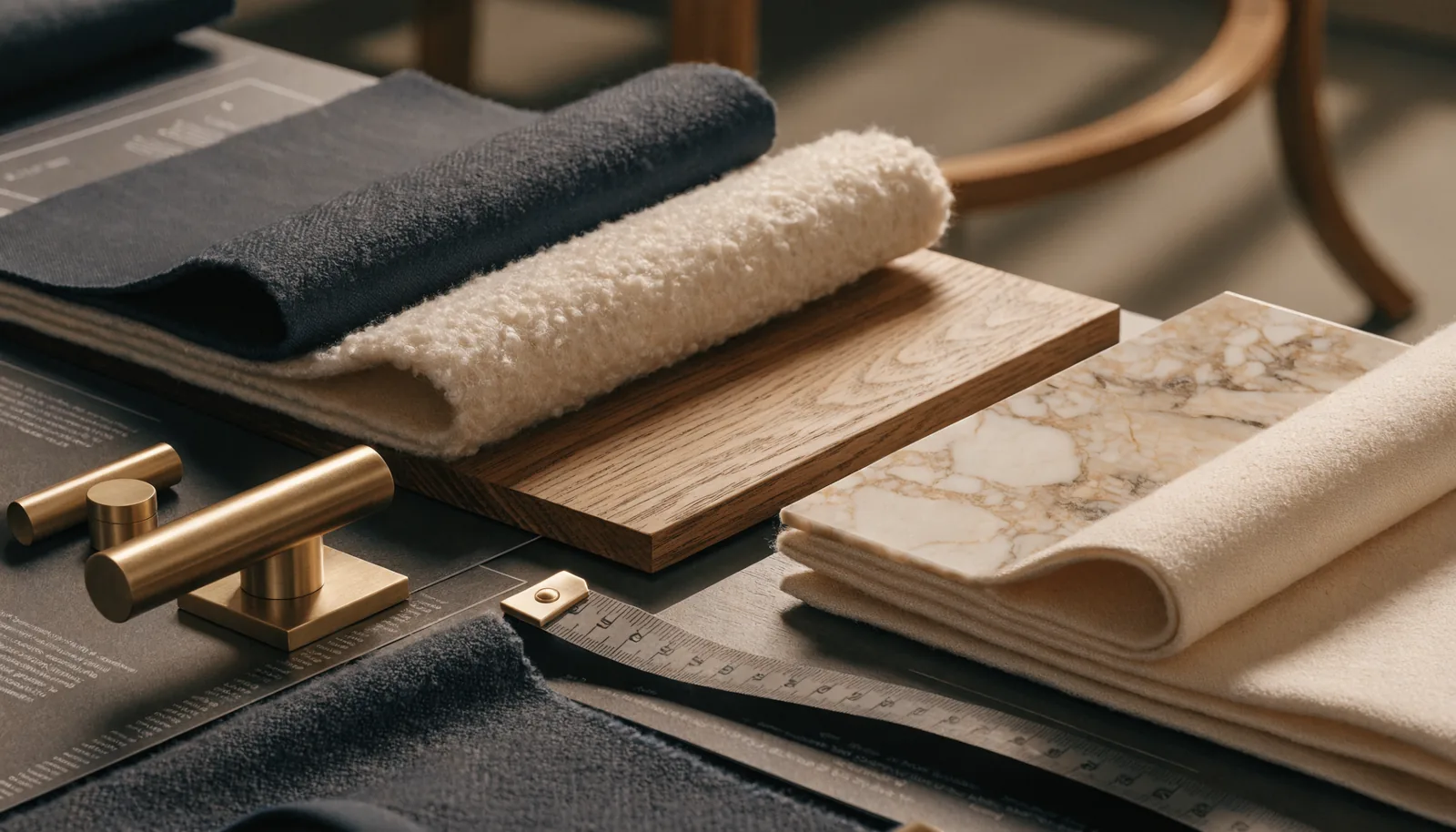
| Natural stone and solid wood interior finishes | Very low inland humidity + wide diurnal temperature swings | Cracking, open joints, and veneer or laminate delamination as the material expands and contracts | Engineered wood with a moisture-stable core, and stone details specified with movement joints rather than tight-fitted seams |
| Powder-coated mild steel furniture frames | Wind-blown sand and dust abrasion + UV | The coating chips or abrades through, exposing bare metal to rust in humid air or flash rain | Powder coat specified with a higher UV-stability rating and greater film thickness, confirmed against the supplier’s abrasion test data rather than a marketing claim |
Why does chloride exposure destroy metal fittings faster than a standard warranty assumes?
Field measurements from Gulf coastal industrial installations — not hotels specifically, but the same open-air metal exposure a beachfront property faces — put the mechanism in numbers: Gulf seawater carries roughly 1.5 times the chloride concentration of normal seawater — one driver behind the salt-laden aerosol that settles on exposed metal — and chloride deposition measured directly on metal surfaces has been recorded above 50 mg/m² using the Bresle method, well into the range that accelerates corrosion.1 Relative humidity in the region runs between 50% and 100% for several months of the year, and exterior surface temperatures occasionally exceed 50°C.1 That combination is what breaks hot-dip galvanizing, the coating most steel fittings rely on by default: the chlorides react with the zinc layer to form soluble zinc chloride, which rinses away in the next humid spell and leaves bare steel behind — often inside the fitting’s stated warranty period, not after it.1
Austenitic stainless steel, frequently specified as the “upgrade” once galvanizing is ruled out, carries its own failure mode here: at sustained high Gulf temperatures, it becomes susceptible to chloride stress corrosion cracking, a cracking mechanism that needs both heat and chloride present together to start.1 Neither failure shows up in a showroom sample or a standard one-year site visit — both take a full exposure cycle through the humid season to appear.
What test standards can a procurement team actually specify?
“Marine grade” and “UV-resistant” are marketing phrases, not specifications. A material clears a Gulf FF&E spec book only when a supplier can produce a certificate against a named, repeatable test:
- ASTM B117 and ISO 9227 — neutral salt spray (fog) testing, run at 35°C with a 5% NaCl solution, used to rate how long a metal coating or finish resists salt-induced corrosion before failure appears.2,3
- ASTM G155 — xenon-arc weathering testing, which exposes non-metallic materials such as upholstery fabric, PVC coatings and laminates to a controlled UV and moisture cycle to rate fading and embrittlement over simulated years of sun exposure.4
Asking for the test and the pass criterion — not just the standard’s name — is what turns this from a checkbox into a real filter. A supplier who can quote hours-to-failure under ASTM B117 or a specific rating under ASTM G155 has actually tested the material; a supplier who only says “marine grade” usually hasn’t.
According to Iwona Stoch, founder of Stoch Hotel Consulting: “On both desert and coastal projects, I look at materials much more broadly than through the lens of aesthetics alone. In both cases, the biggest mistake is specifying a material that looks good in the showroom but starts degrading within a year or two on site.”
Does the same specification work for a desert property and a coastal resort?
No — and treating “GCC” as one climate is the single most common specification error we see. An inland Riyadh property and a Red Sea coast resort share a supplier list and a regional building code, but not a damage profile. A spec book built for one should not be reused unchanged for the other; the material categories that need re-checking are exactly the ones in the table above — exterior metal, outdoor upholstery, and any interior stone or solid wood exposed to swings in indoor humidity control. This is also where a project’s independent FF&E and OS&E procurement advisory for the Middle East and GCC earns its place before tender — catching a climate mismatch in the spec book costs a redline; catching it after installation costs a replacement cycle.
The same logic that governs fabric durability testing for hotel interiors generally — covered in what Martindale, rub counts and flame ratings mean for contract textiles — applies here to UV and salt exposure specifically: a named test and a stated pass threshold, not a marketing label. And for Saudi projects specifically, the material compliance conversation doesn’t stop at durability testing — it continues into SABER/SASO import certification and the lead times it adds, and for Red Sea coast sites, into the logistics realities of getting that FF&E to a remote coastal site once it’s specified correctly.
Frequently asked questions
What’s the difference between desert climate damage and coastal Gulf climate damage to hotel FF&E?
Desert conditions — intense UV, extreme heat, dust and sand, very low humidity and wide day-night temperature swings — mainly dry out and crack solid wood, stone and rigid plastics. Coastal conditions — the same UV load plus salt-laden air, sustained humidity and wind — mainly corrode metal fittings and fade or embrittle fabrics and coatings. Both share UV as a common stressor, but the dominant failure mode is different.
Which test standards should a hotel specify to verify FF&E durability in the Gulf?
For metal fittings and finishes exposed to salt air, specify a result against ASTM B117 or ISO 9227 (salt spray/fog testing). For outdoor upholstery fabric, PVC coatings and laminates exposed to UV, specify a result against ASTM G155 (xenon-arc weathering testing). Ask for the supplier’s actual test result, not just a claim that the material is “marine grade” or “UV-resistant.”
Why does galvanized steel fail faster in coastal Gulf hotels than inland ones?
Hot-dip galvanizing protects steel with a zinc coating, but the chloride-heavy salt aerosol along the Gulf coast reacts with that zinc layer to form soluble zinc chloride, which washes away in humid weather and leaves the underlying steel exposed to corrosion. Inland desert sites don’t carry the same chloride load in the air, so galvanized steel there fails by a different route, mainly UV and abrasion on any coating layered over it.
Can a material that looks right in the showroom still fail on site?
Yes — this is the most common specification mistake on both desert and coastal projects. A showroom sample sits under controlled light and handling for a few weeks at most; it never sees a full humid season, a full summer of UV exposure, or repeated wind-blown sand. A material only proves itself once it has been tested against a named standard for the specific stress it will face on that project.
Does this apply only to outdoor furniture, or to interior FF&E as well?
Both. Outdoor and semi-exposed FF&E — railings, loose furniture, upholstery — face the most direct UV, salt and sand exposure. But interior FF&E is not exempt: natural stone and solid wood finishes inside an inland desert property still crack and open at the joints if indoor humidity control isn’t specified and maintained alongside the material choice.
Iwona Stoch is the founder and strategic lead of Stoch Hotel Consulting, an independent FF&E and OS&E procurement consultancy based in Kraków, working with luxury and upscale hotels across Europe and, through its Middle East & GCC advisory services, the Gulf since 2011.
Last updated: September 2026.
Specifying FF&E for a desert or coastal Gulf hotel project? Stoch Hotel Consulting’s Middle East & GCC procurement advisory reviews material specifications against the climate the project actually sits in, before the purchase order is placed. Get in touch to talk through your project’s material specification.
Sources: 1 Ibrahim A. Muzghi, Qatargas, “Fastener Corrosion in Arabian Gulf Offshore Installations,” OSTI/ETDE technical report. 2 ASTM International, ASTM B117, “Standard Practice for Operating Salt Spray (Fog) Apparatus.” 3 Q-Lab Corporation, “ISO 9227 — Corrosion Tests in Artificial Atmospheres.” 4 Q-Lab Corporation, “ASTM G155 — Xenon Arc Light Apparatus for Non-Metallic Materials.”