By Iwona Stoch, Founder & Strategic Lead, Stoch Hotel Consulting
Guests rarely complain about “lighting” by name, yet weak or confusing guest-room lighting sits behind reviews that mention a dark room, a room that “felt cheap,” or a night spent fumbling for the right switch. The fit-out causes are usually bedside controls guests can’t reach and the wrong color temperature.
Lighting is one of the fit-out categories guests feel the most and describe the least. A guest who cannot find the right switch at 11pm does not write “the lighting control logic was unintuitive” — they write “couldn’t relax,” “room felt gloomy,” or nothing at all, and simply remember the stay as slightly worse than it was. That gap between what guests feel and what they name is exactly why guest-room lighting keeps failing fit-out audits even at hotels with strong service scores. This is a look at where lighting fit-outs actually go wrong, what the guest-room lighting fails to control, and what a hotel can specify differently.
What is the difference between decorative and architectural lighting in a hotel room?
Architectural lighting is the fixed, functional layer built into the room’s electrical fit-out — recessed ceiling downlights, wall-washers, under-cabinet task lighting — installed to provide general illumination and support specific tasks like reading or grooming. Decorative lighting is the layer guests actually touch and see as objects: bedside lamps, wall sconces, a floor lamp in the seating area, chosen as much for how they look as for how much light they produce. A hotel room needs both working together, but in fit-out audits the two layers get evaluated by completely different standards: architectural lighting is judged on levels and color, decorative lighting is judged on how it feels in a guest’s hand at midnight.
That distinction matters because the failures cluster differently. Architectural lighting fails on color temperature and glare. Decorative lighting fails on control — where the switch is, how it’s labeled, and whether it survives being handled by someone half-asleep.
Which guest-room lighting mistakes come up most often in a fit-out audit?
In the fit-out audits Stoch Hotel Consulting runs, the same handful of lighting failures recur across otherwise well-specified rooms, and they cluster around control more than around brightness.
According to Iwona Stoch, founder of Stoch Hotel Consulting, the pattern is consistent: “no way for the guest to control the bedside light, or a control system that’s too complicated. A poorly chosen bulb color. Any light fixture the guest actually touches needs its switches and dimmers within reach and within sight, and needs to be built very solidly.”
The table below maps that observation to the specific light point, what it’s supposed to do, and where the fit-out spec usually goes wrong.
| Light point | Function | Typical fit-out failure |
|---|---|---|
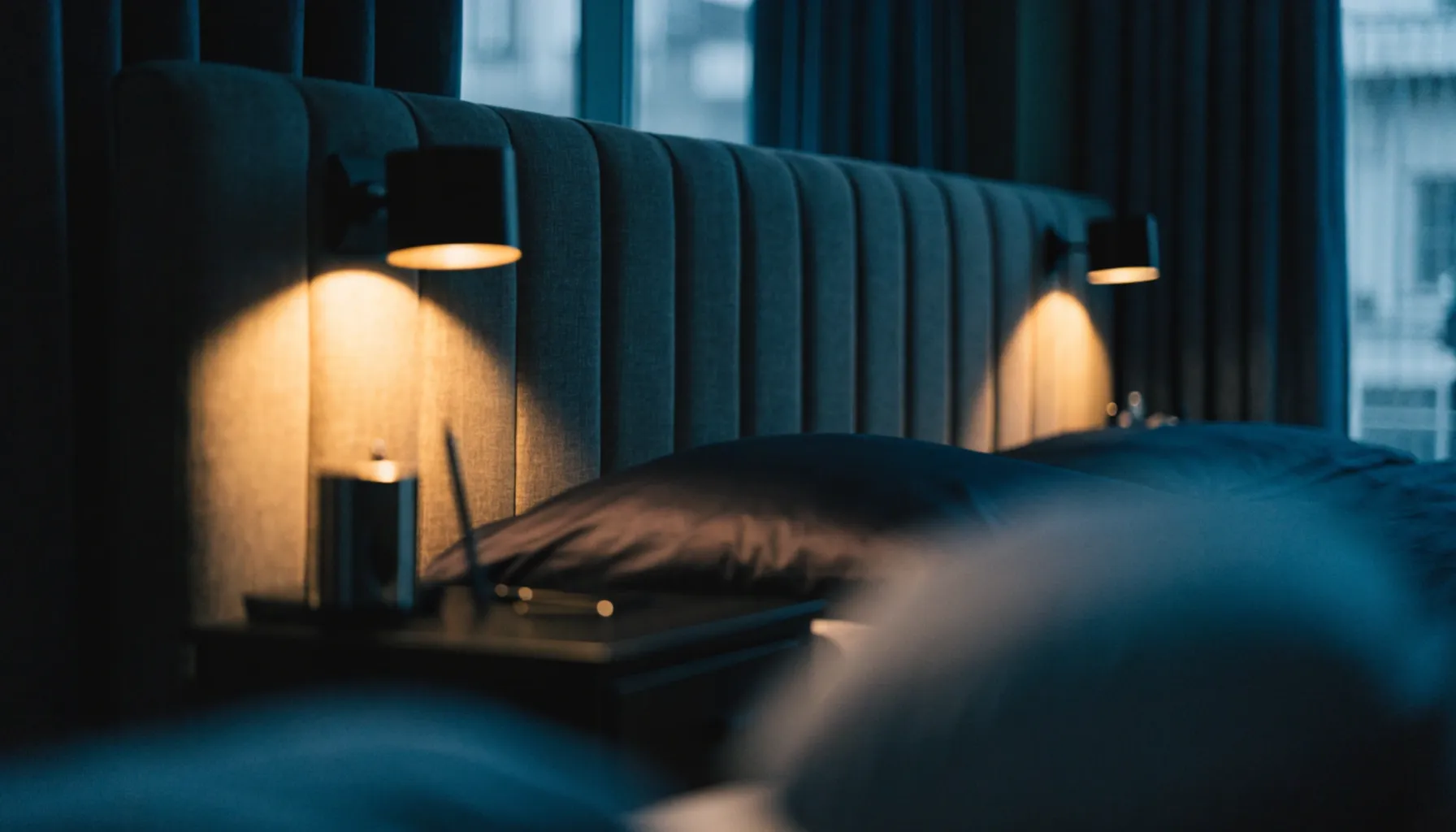
| Bedside reading light | Task lighting for reading or working from bed | No guest-side control at all, or a control panel too complicated to use without getting up |
| Bedside switch / dimmer | Lets the guest adjust light without leaving the bed | Placed out of reach or out of sight, or built from a switch that feels flimsy under a guest’s hand |
| General / ambient lighting | Overall room brightness and orientation on arrival | Wrong color temperature — too cool and clinical, or too warm and dim to see by |
| Desk or vanity task light | Grooming, make-up, working at the desk | Low color rendering — skin tones and colors look off under the fixture |
| Decorative fixture (lamp, sconce) | Atmosphere and brand aesthetic | Specified for how it looks in a rendering, not for how solidly its switch is built |
What color temperature and CRI should hotel guest-room lighting use?
Hospitality lighting guides generally recommend a correlated color temperature (CCT) of 2700–3000K for guest rooms — a warm white rather than the cooler, bluer light used in offices or retail — paired with a Color Rendering Index (CRI) of 90 or higher so skin tones and fabrics read accurately rather than washed out or greyish. Diane Erich & Associates, a hospitality design and procurement firm, sets exactly that specification in its 2025 hotel lighting guide: CCT of 2700–3000K for guestrooms and lounges (with a warmer 3000–3500K for active F&B spaces), and a CRI of 90 or higher across both. A room lit outside that range does not usually generate a complaint about “color temperature” — it generates a complaint that the room “felt cold” or “felt cheap,” because guests read the wrong Kelvin value as an atmosphere problem, not a specification problem.
Getting the color temperature right also touches the same guest need that shapes mattress and bedding procurement: a guest winding down for the night needs the room to visibly shift toward warmer, dimmer light in the evening, not stay lit like a workspace until the moment they turn everything off.
Why do overly complicated lighting controls hurt the guest experience more than dim bulbs do?
Because a guest who cannot operate the lighting does not experience a lighting problem — they experience a competence problem, and it colors the rest of the stay. A 2025 survey of more than 450 hotel properties globally by Hotels.com, an Expedia Group brand, found that lighting is among the systems guests most commonly struggle with at check-in, alongside Wi-Fi, entertainment systems and air conditioning — common enough that half of the surveyed hotels now offer guests a verbal tech walkthrough at check-in specifically to explain smart lighting and other in-room systems. See the Hotels.com survey on guests struggling with smart hotel room lighting.
That a hotel needs to staff a verbal walkthrough of the lighting system is itself the finding: it means the control logic failed the guest before they ever touched a switch, and the front desk is now compensating for a fit-out decision at check-in, every single arrival, for as long as that control system stays installed. A bedside switch a guest can find in the dark, with a dimmer that does one obvious thing, needs no explanation and generates no complaint — which is a cheaper outcome than training staff to explain a system a guest will only use for one night.
How does lighting fit into a broader fit-out audit?
Lighting and controls is one of the categories we check specifically in a structured hotel fit-out audit, alongside the other categories — bathroom counter space, water pressure, bed comfort — that make up most of what shows up in reviews as vague dissatisfaction rather than a named complaint. The pattern is the same one behind why guests complain about a hotel room without naming the fit-out cause: the guest reports the symptom, and the specification decision that caused it is invisible to everyone except whoever walks the room with a checklist.
Frequently asked questions
Is guest-room lighting really a fit-out issue, or is it a maintenance issue?
Both can occur, but they are different problems. A burnt-out bulb or a broken dimmer is maintenance. A control panel guests cannot understand, a switch placed out of reach, or the wrong color temperature specified across the whole room type is a fit-out decision — it will produce the same guest experience at every stay in every room of that type until the specification changes.
What color temperature should hotel guest-room lighting use?
Industry lighting guides for hospitality generally recommend 2700–3000K with a CRI of 90 or higher for guest rooms, to keep the light warm and to render skin tones and furnishings accurately rather than washed out.
Why do lighting control systems cause more complaints than dim lighting itself?
Because a lighting level can be adjusted once it’s noticed, but a control system a guest cannot operate creates friction at the exact moments — arrival, and getting into bed — when guests are least willing to troubleshoot. That friction gets remembered as a bad night, not as a lighting-control problem.
Can a hotel fix guest-room lighting without an electrical fit-out?
Sometimes. Decorative fixtures, bulb color temperature within an existing fixture, and even some switch and dimmer hardware can often be replaced without touching the room’s wiring. A lighting layout that requires new circuits, additional switch locations, or a different control system does require an electrical fit-out.
Iwona Stoch is the founder and strategic lead of Stoch Hotel Consulting, an independent FF&E (furniture, fixtures and equipment) and OS&E (operating supplies and equipment) procurement consultancy based in Kraków, working with luxury and upscale hotels across Europe since 2011.
Last updated: August 2026.